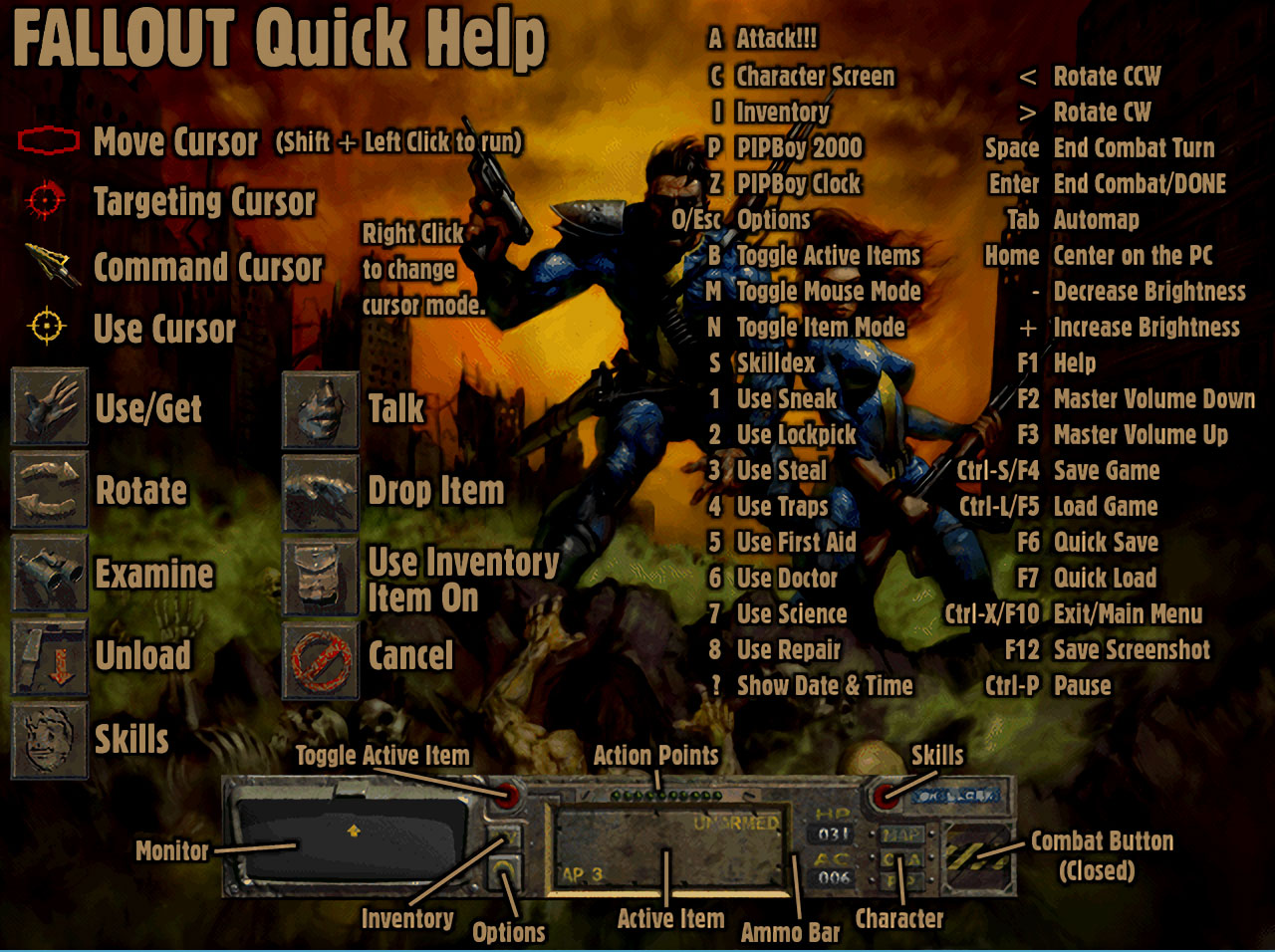
Basic Fallout 1 Controls
These are your go-to shortcuts for most actions, including combat, making your post-apocalyptic adventure smoother and more enjoyable.
- [Esc]: Open the pause menu.
- [Tab]: View the local map.
- [Enter]: End combat.
- [Space Bar]: End your turn in combat or end combat if safe.
- [Arrow Keys]: Move the camera.
- [Home]: Center the camera on your character.
-
[1 ~ 8]: Activate corresponding skills:
- [1]: Sneak
- [2]: Lockpick
- [3]: Steal
- [4]: Traps
- [5]: First Aid
- [6]: Doctor
- [7]: Science
- [8]: Repair
Inventory and Menus
Quick access to your inventory and various menus.
- [I]: Open inventory (uses 4 AP in combat).
- [O]: Open the pause menu.
- [P]: Open Pipboy.
- [A]: Start combat.
- [S]: View skills.
- [Z]: Rest for a set time (not available everywhere or in combat).
- [C]: View character stats.
- [B]: Swap equipped items (no AP cost in combat).
- [N]: Cycle through alternate actions with your equipped item.
- [M]: Change cursor mode.
Multi-Key Shortcuts
Combination shortcuts for quick actions.
- [Ctrl] + Q: Quit the game.
- [Ctrl] + X: Quit the game.
- [Ctrl] + P: Pause the game.
- [Ctrl] + S: Save game.
- [Ctrl] + L: Load game.
- [Ctrl] + M: End combat.
Movement and Interaction
Efficient ways to move and interact within the game.
- [Shift] + Left Mouse Button: Run to cursor location.
Dialogue and Inventory
Shortcuts specific to dialogue and inventory management.
- [Esc]: Close menus or cancel barter.
- [Arrow Keys]: Scroll through inventory.
- [0 ~ 9]: Choose a dialogue option.
- [A]: Ask.
- [B]: Barter.
- [Ctrl] + Arrow Keys: Scroll through another inventory.
Other Useful Shortcuts
Additional shortcuts for utility and aesthetics.
- [F6]: Quicksave.
- [F7]: Quickload.
- [Display Date/Time]: Show in-game date and time.
- [Ctrl] + V: Display game version.
Released in 1997 by Interplay Productions, Fallout 1 is a seminal title that laid the groundwork for one of the most beloved franchises in gaming history. Set in a post-apocalyptic world, the game combines deep role-playing mechanics with a rich narrative, creating an experience that has stood the test of time. Let’s explore what makes Fallout 1 a classic that continues to resonate with gamers today.
The game is set in the aftermath of the Great War, a catastrophic nuclear conflict that occurred on October 23, 2077. The war lasted less than two hours but left the world in ruins. Players step into the shoes of the Vault Dweller, a resident of Vault 13, who is sent on a mission to find a replacement water chip to save their vault from dehydration.
Character Creation and SPECIAL System
One of the standout features of “Fallout 1” is its character creation system. Players can choose from three pre-made characters or create their own, customizing attributes using the SPECIAL system. This system includes seven primary statistics: Strength, Perception, Endurance, Charisma, Intelligence, Agility, and Luck. Each attribute influences gameplay, allowing for a variety of playstyles and meaningful decisions that impact the game’s outcome.
Gameplay and Mechanics
Fallout 1 offers a blend of exploration, combat, and dialogue, all set in an open world. Players navigate the devastated landscape, encountering mutants, gangsters, and robotic adversaries. The game provides multiple ways to approach challenges, whether through combat, stealth, or diplomacy. This flexibility in gameplay, combined with a branching narrative, ensures that no two playthroughs are the same.
The main quest revolves around finding the water chip, but the game is rich with side quests and hidden stories that add depth to the world. Players will encounter various factions and characters, each with their own agendas and backstories. The choices made during these interactions can lead to different endings, adding replay value and a sense of agency.